Table of Contents
Introduction
Why tNavigator 25.4 Key Updates Matter Now
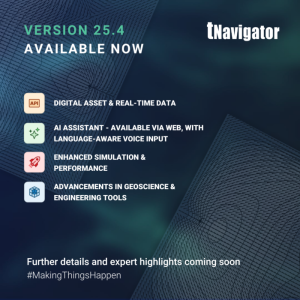
tNavigator 25.4 key updates arrive at a pivotal moment for upstream oil and gas operations. Reservoir and production engineers are expected to deliver faster forecasts, manage increasing subsurface uncertainty, and support long-term asset performance—often with tighter budgets, fewer resources, and shorter decision cycles.
Modern reservoirs are more complex than ever. Mature fields require continuous optimization, unconventional assets demand high-resolution modeling, and new developments must be evaluated under increasing economic and sustainability constraints. In this environment, traditional workflows that rely on disconnected software tools, slow simulation runtimes, and manual iteration are no longer sufficient.
Developed by Rock Flow Dynamics, tNavigator is a state-of-the-art integrated reservoir modelling and simulation platform designed to unify geoscience, reservoir engineering, and production engineering within a single environment. With version 25.4, the platform introduces meaningful enhancements that directly address the day-to-day challenges faced by subsurface teams.
This article explores the tNavigator 25.4 key updates, not as a simple feature list, but through the lens of practical engineering impact—explaining what has changed and why it matters for real-world reservoir and production decision-making.
Understanding tNavigator as an Integrated Platform
Integration at the Core of tNavigator Technology
Before examining the details of the tNavigator 25.4 key updates, it is essential to understand what fundamentally differentiates tNavigator from conventional reservoir simulators.
A Single Platform from Geoscience to Production
tNavigator is built as an integrated-by-design technology, meaning that data, models, and workflows are kept within a single, consistent platform rather than spread across multiple disconnected applications. This integrated architecture enables:
- Seamless progression from geophysical interpretation to static reservoir modeling
- Direct transition from geological models to dynamic reservoir simulation
- Immediate feedback between subsurface behavior and production performance
By eliminating the need for frequent data export, conversion, and re-import, tNavigator reduces errors, shortens project timelines, and preserves model integrity.
Why Integration Improves Decision Quality
When geoscientists, reservoir engineers, and production engineers work in silos, assumptions can diverge, uncertainties multiply, and decision-making slows. Integrated workflows ensure that all disciplines operate from the same model foundation, improving collaboration and alignment across teams.
tNavigator 25.4 Key Updates for Reservoir Simulation Performance
GPU-Accelerated Simulation at Geological Scale
One of the most impactful tNavigator 25.4 key updates is the continued optimization of GPU-accelerated reservoir simulation, a core strength of the platform.
Unlimited Acceleration Using GPU & CPU Hardware
tNavigator performs dynamic modelling and simulation at geological scale while fully utilizing available GPU and CPU hardware. In version 25.4, improvements include:
- Enhanced parallelization efficiency across hardware resources
- Improved solver stability for large, complex reservoir models
- Better scalability when running multiple scenarios simultaneously
These enhancements allow engineers to maintain high-resolution geological detail without sacrificing runtime performance.
Why Faster Simulation Matters in Practice
For reservoir engineers, faster simulation directly translates into:
- More development scenarios evaluated within project timelines
- Faster turnaround for field development plans and updates
- Improved sensitivity analysis and risk evaluation
For production engineers, faster simulation enables quicker assessment of operating strategies, well controls, and surface constraints—supporting more responsive operational decisions.
tNavigator 25.4 Key Updates for Assisted History Matching & Uncertainty
Smarter Automation That Supports Engineering Expertise
History matching is widely recognized as one of the most time-consuming and technically demanding steps in reservoir studies. The tNavigator 25.4 key updates strengthen assisted history matching and uncertainty quantification workflows to improve both efficiency and confidence.
Automation Without Losing Engineering Control
tNavigator combines automation, parallelized computation, and artificial intelligence in a unified environment designed to support engineering judgment rather than replace it. Version 25.4 introduces refinements such as:
- Enhanced assisted history matching workflows
- Improved parameter handling across diverse reservoir models
- More efficient management of uncertainty scenarios
These improvements reduce repetitive manual tasks while keeping engineers firmly in control of model assumptions and interpretation.
Practical Benefits for Engineering Teams
With the tNavigator 25.4 key updates, engineering teams can expect:
- Reduced manual trial-and-error during calibration
- Clearer understanding of uncertainty ranges
- More reliable production forecasts for planning and decision-making
This is particularly valuable for assets where models must be updated frequently as new production data becomes available.
tNavigator 25.4 Key Updates for Reservoir-to-Surface Integration
End-to-End Modelling in One Environment
Integration from reservoir to surface has always been a defining feature of tNavigator, and version 25.4 further strengthens this capability.
Connecting Reservoir Behavior and Surface Constraints
By keeping reservoir models, wells, and surface networks within the same platform, engineers can:
- Evaluate subsurface behavior and surface limitations simultaneously
- Identify production bottlenecks early in the planning process
- Test optimization scenarios without data transfer delays or errors
This end-to-end modeling approach provides a more realistic representation of field performance.
Why Reservoir-to-Surface Integration Is Critical Today
Modern assets are increasingly constrained by surface capacity, facility limitations, and operational considerations. The tNavigator 25.4 key updates help teams understand these interactions early, reducing the risk of late-stage design changes and operational surprises.
tNavigator 25.4 Key Updates Improving Daily Engineering Workflows
Enhanced Usability and Workflow Efficiency
Beyond physics and performance, several tNavigator 25.4 key updates focus on improving daily usability—an often overlooked but critical factor in engineering productivity.
Streamlined Navigation and Visualization
Version 25.4 introduces refinements that improve:
- Model navigation and visual clarity
- Scenario setup and comparison
- Interpretation and communication of simulation results
These enhancements reduce friction in daily tasks, particularly for large, multidisciplinary studies involving multiple stakeholders.
Supporting Cross-Disciplinary Collaboration
Because all disciplines work within a single environment, geoscientists, reservoir engineers, and production engineers can collaborate more effectively. Updates in version 25.4 help teams align assumptions faster and reduce rework.
Business Impact of tNavigator 25.4 Key Updates
Faster Decisions with Lower Risk
While technical in nature, the tNavigator 25.4 key updates deliver tangible business benefits:
- Shorter study timelines
- Improved forecast confidence
- Better understanding and communication of uncertainty
These advantages enable faster, more confident decision-making at both technical and management levels.
Stronger Asset Performance
From a portfolio perspective, operators benefit from:
- More effective production optimization
- Better evaluation of recovery strategies
- Reduced risk of costly late-stage changes
Over time, these improvements can contribute to higher recovery, improved asset value, and better capital efficiency.
Who Should Upgrade to tNavigator 25.4?
Ideal Users for tNavigator 25.4 Key Updates
tNavigator 25.4 is particularly relevant for:
- Reservoir engineers working with large, high-resolution models
- Production engineers managing integrated reservoir and surface systems
- Subsurface team leads responsible for cross-domain studies
- Asset managers seeking faster, more reliable technical decision support
For organizations that rely on frequent scenario testing, uncertainty analysis, and integrated modelling, upgrading to version 25.4 provides immediate operational value.
Read More: tNavigator 25.4 Key Updates Now Available
Conclusion
Turning tNavigator 25.4 Key Updates into Confident Decision
The tNavigator 25.4 key updates go beyond incremental feature enhancements. They strengthen the platform’s ability to deliver faster simulation, smarter automation, and deeper integration—capabilities that directly support confident engineering and business decisions.
By keeping data, models, and expertise in a single environment, tNavigator 25.4 enables teams to focus less on managing tools and more on understanding reservoirs, optimizing production, and maximizing asset value.
Work With Kejora
As the authorized representative of tNavigator in Indonesia, PT Kejora Gasbumi Mandiri supports operators in evaluating, implementing, and optimizing advanced subsurface technologies.
Interested in exploring how tNavigator 25.4 can enhance your reservoir and production workflows? Connect with PT Kejora Gasbumi Mandiri today to discuss an upgrade, request a technical walkthrough, or schedule a product demonstration.
Read More: Kejora Product tNavigator